No items found.
Understanding the process of an NHS CT scan is essential to help you make an informed decision on whether this route is best for your needs.
Getting a CT scan on the NHS involves several steps. The process begins with a clinician requesting the examination and scan. Next, a radiographer takes detailed images. From there, a radiologist interprets the images, and the referring team explains the result.
Why a CT scan may be requested
Short for Computed Tomography, a CT scan produces images in cross-sections, also known as slices. A GP may request this test to assess bones or internal organs after an injury, further investigate symptoms of health concerns, or determine whether any procedures may be needed. These are specific clinical questions, rather than a general check of every part of the body. The NHS describes these uses of CT.
The request also needs to be approved. UKHSA's medical imaging guidance explains that a healthcare professional sends the scan request to a radiologist, who decides whether the examination is needed. Whether or not the scan is approved is determined by the reason it has been requested by the clinician.
What the appointment involves
Preparation depends on the examination that has been requested by your referring clinician. University College London Hospitals advises that patients use the hospital appointment letter and patient information provided, rather than a generic fasting or medication checklist. If anything is unclear, ask the department conducting the exam before attending.
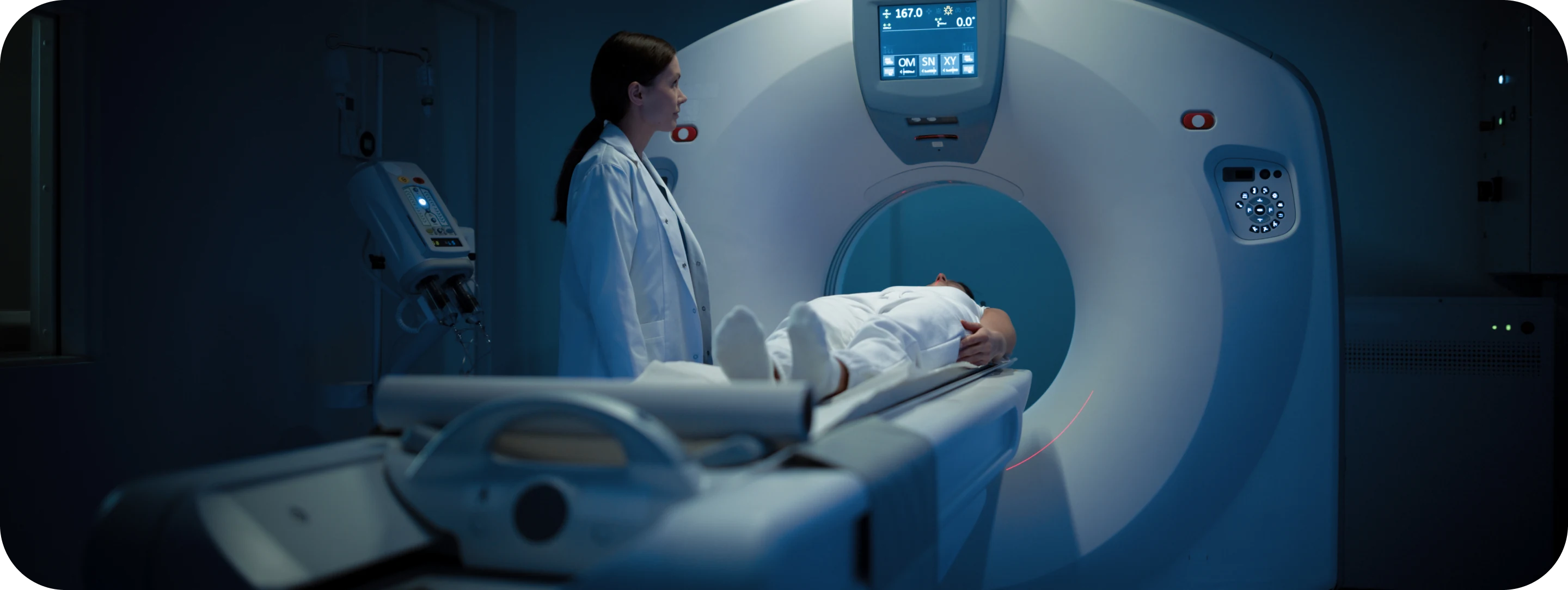
During the scan, you will lie flat on a flat bed that moves you through a ring-shaped scanner.
A radiographer operates the scanner from another room and can hear and speak to you during the scan. Some examinations involve brief breath-holds. NHS information on the CT appointment explains how this could work.
In its May 2026 patient guide, University College London Hospitals (UCLH) states that you will pass through the scanner several times. If injected contrast is needed, a small tube called a cannula is inserted into a vein. The dye helps show blood vessels and organs more clearly. You may briefly feel a warm feeling, a metallic taste or a sensation of needing the toilet during injection.
Contrast is part of the specific examination, rather than an optional CT upgrade. UCLH also explains that potential contrast reactions are assessed through safety questions. Your team's instructions determine the safety checks and aftercare that may be needed.
According to Guy's and St Thomas' NHS Foundation Trust, the scan itself differs from the longer time a patient may spend in the department. Ask the hospital how much time to allow, especially if you need transport or support.
Radiation and the limits of the examination
CT uses X-rays, which are ionising radiation. According to UKHSA, the benefit must outweigh the radiation risk for the test. That judgement depends on the reason for the scan, rather than a claim that CT is always the right test.
The CT result may lead to further investigation. NHS guidance explicitly notes that further tests may still be needed as images contribute to assessment rather than giving answers to every possible concern.
What a waiting time number means

According to NHS England DM01 Guidance (v9, March 2026), CT diagnostic waiting time generally starts when the test is requested and ends when it is done. The monthly waiting-list figure is an overview of people still waiting for tests at month-end.
The wait period excludes time before the request, including the clinical assessment, and time afterwards for reporting, discussing findings, and determining further care. This wait time applies to services in England. It is not a personal appointment estimate or the length of the whole patient journey.
When asking about your wait, consider whether you are waiting for the CT appointment, the radiologist's report, or a discussion with the referring team. Each will affect your own wait period.
How you get your CT results
A radiologist examines the images and sends a report to the clinician who requested the scan. The referring team then explains what the findings mean and whether any further appointments or tests are needed. The NHS guidance on CT results explains a typical process to get your results.
This may not apply to all regions. A national estimate cannot promise your result date.
As of October 2026, Guy's and St Thomas' tells patients to allow two weeks for results to reach the referring doctor. That is a reporting interval, not a guarantee of finding discussion by that date.
Cambridge University Hospitals advises patients to expect a three-week delay between an examination being reported and its release through MyChart (as of October 2026). The referring team remains responsible for discussing the report. Portal release, report completion, and discussion are considered separate events.
Before leaving, ask who will explain your result and how to contact them if the expected time passes. If you do not understand the report, ask for an explanation rather than trying to decide your next treatment from the wording alone.
If symptoms worsen while you are waiting, seek advice from your GP or NHS 111. Call 999 for sudden face drooping, arm weakness, or speech difficulty, even if they stop, as these can be signs of a stroke. A private scan is not the route for an emergency.
Considering a private CT scan
GetScanned's private CT scan service offers a self-referral route for non-urgent questions, with consultant radiologist reporting. Its booking process includes a GetScanned GP call to review your history and issue the referral. You do not need to arrive with a referral already arranged by your own GP.
GetScanned arranges the scan and shares the report and images. A post-scan GP consultation can be requested.
Before booking, determine who will explain the findings and organise any further care. If you want your NHS team to use a private examination, discuss that first rather than assuming the booking also covers your next treatment.
Conclusion
The path to getting answers becomes simpler once you have a better understanding of the process. Whether you choose to book a private scan or proceed with an NHS scan, the most important thing is getting the answers you need.
GetScanned Today
Thank you! Your submission has been received!
Oops! Something went wrong while submitting the form.
FAQ
When would a CT scan be needed?
A CT scan is typically requested by your GP in the event of injury, joint problems, unexplained pain, or any other symptoms that may indicate that organs are not functioning properly.
What can I expect when requesting a CT scan on the NHS?
The process involves an examination by your GP, a referral to the NHS, the scan itself, the report that is compiled by the radiologist, and then a discussion with your team to explain the findings.
How long do I wait for my results?
This will vary by hospital and region. Typically, you can expect to wait between 2 and 3 weeks. See our guidance on waiting times to understand how they work.
Sources
NHS: CT scan supports clinical uses, scanner, reporting and further tests.
UKHSA: medical imaging supports request checks and individual radiation benefit-risk assessment.
UCLH: having a CT scan supports cross-sectional imaging, contrast, sensations and appointment-specific instructions.
NHS England: DM01 v9 supports CT inclusion, snapshot and clock definitions.
Guy's and St Thomas': CT appointments supports appointment stages and its local report interval.
Cambridge University Hospitals: CT information supports its MyChart release process.
NHS: stroke symptoms supports emergency escalation.
GetScanned: CT service and booking process support its own offering only.