No items found.
The biggest factor is which examination you actually need: an MRI of the internal auditory meatus (IAM), a broader head scan, an angiogram or a CT are different tests at different costs. After that, quotes vary on whether they include contrast dye, a clinical review, a radiologist's report and a follow up discussion.
Why "ear MRI" has no single price
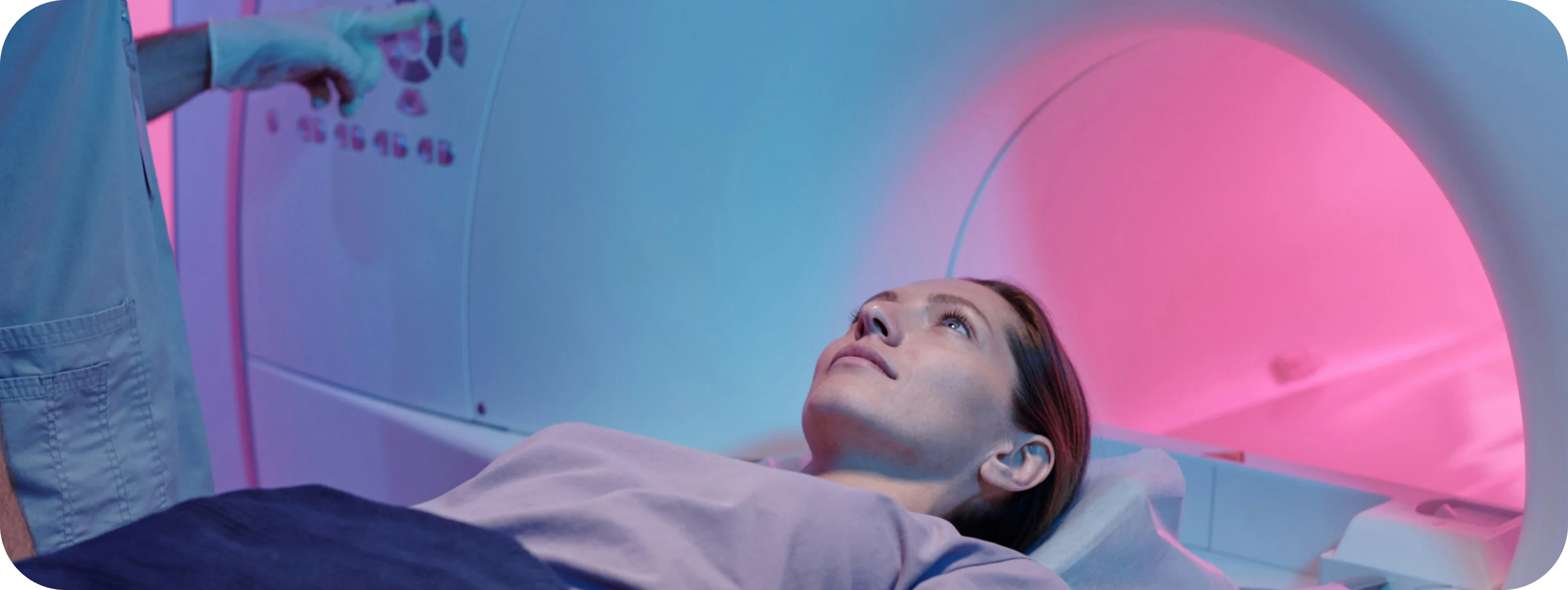
"Ear MRI" is not one examination. For a suspected problem with the hearing or balance nerve, the usual test is an MRI of the internal auditory meati, the two narrow canals that carry those nerves from the inner ear to the brain. That is a focused scan, not the same as a general brain MRI. Other ear questions call for different imaging entirely, so two quotes for an "ear scan" may not be for the same thing.
Start with a hearing test
For most adults with hearing problems, the first step is a hearing test (audiometry), not a scan. The NHS notes you can sometimes get a free hearing test at some pharmacies and opticians.
The result matters because it shapes whether a scan is needed at all. NICE guidance on hearing loss in adults says clinicians should:
- offer an IAM MRI to adults with hearing loss and symptoms or signs pointing to a specific cause, such as facial nerve weakness, whatever the hearing test shows
- consider an IAM MRI when a hearing test shows one ear is worse than the other by 15 decibels or more at two neighbouring test frequencies, with no other signs
Without that hearing test, neither you nor a clinician can tell which group you fall into.
When the right test is not an IAM MRI
MRI and CT show different things. In its evidence review on tinnitus, NICE notes that CT with contrast is better at showing bone, while MRI is better for soft tissue and structures inside the skull. When a middle ear or bony cause is suspected, NICE's committee considered a CT of the temporal bone the best first test.
Tinnitus that pulses in time with your heartbeat is a different question again. NICE suggests it may need an MR angiogram or an MRI covering the head, neck, temporal bone and IAM, chosen after an examination and hearing assessment. That is a larger examination than an IAM scan, and usually priced as one. This choice should follow a clinical assessment, not the lowest quote.
What changes the price of the same examination
Once the examination is clear, check what each quote covers:
- The protocol: IAM imaging alone, or a broader head scan.
- Contrast dye: some scans need an injection of contrast, which adds to the cost and requires a safety check first. As a guide to the difference, NHS reference costs used by NICE in 2017 to 2018 put a two area MRI at £152 without contrast and £202 with it. These are NHS internal costs, not prices you would pay.
- Clinical review: whether a doctor checks the scan is right for your question before you book.
- The report: who reports the images, for example a consultant radiologist.
- Follow up: whether a discussion of the results with a doctor is included or extra.
- Location: prices vary between clinics and regions.
Sudden hearing loss is urgent
If you lose hearing suddenly in one or both ears, ask for an urgent GP appointment or contact NHS 111. The NHS says it may need to be treated quickly, and NICE advises that hearing loss which came on suddenly within the past 30 days is seen by a specialist within 24 hours. If hearing loss on one side comes with face drooping or numbness, call 999, because it can be a sign of a stroke. Booking an elective scan is not the route for either.
GetScanned Today
Thank you! Your submission has been received!
Oops! Something went wrong while submitting the form.
Getting a quote from GetScanned
You do not need a GP referral. A GetScanned doctor first reviews your history and whether the scan and body area you have chosen fit your clinical question, which is where the choice between an IAM scan and a broader examination is checked. You receive the radiologist's report and images, and you can request a consultation with a GetScanned GP to discuss them. The private MRI scan page has the current prices and booking details.
Sources
NICE, Hearing loss in adults: assessment and management (NG98): when an IAM MRI should be offered or considered, the 15 dB hearing test threshold, and urgent referral for sudden hearing loss.
NICE, Tinnitus (NG155), evidence review K: imaging for pulsatile tinnitus: CT versus MRI for bone and soft tissue, imaging for pulsatile tinnitus, and NHS reference costs with and without contrast.
NHS, Hearing loss: free hearing tests at some pharmacies and opticians, and urgent advice for sudden hearing loss.
NHS, Symptoms of a stroke: stroke warning signs and when to call 999.
GetScanned, Private MRI scan: current prices, booking and doctor review.